
Grip underfoot, not looks
Driveway and Sidewalk Moss Removal in Nanaimo
Wet moss turns a sloped driveway, a set of steps or a shaded path into a slip risk. We wash it off at low pressure first and raise it only where the surface needs it.
Customer reviews
What customers say
They do a great job and provide great customer service! They are always reliable. Thank you,
Great experience working with this company! Quick turn around time and very professional. I’ll definitely be using their services again in the future.
Great job and fair pricing! Will hire again!
Why us
Why customers love our service
And why you will get the best moss removal service in Nanaimo!
Fast and efficient moss removal
We turn up on the day we said, clear the whole roof, and get off your property without stretching the job out.
Clear and quick communication
You get an answer when you call or text, a price before we start, and a straight account of what we found up on the roof.
Five-star reviews
Consistent five-star reviews from the homeowners our crew works for.
Clearing moss since 2021
Asphalt shingle, cedar shake, tile and metal roofs, and the driveways and paths below them.
- A walk over every surface to note its material, age and any soft spots
- Heavy moss, needle mats and leaf litter scraped and swept off first
- Drains, beds and the downhill edge protected before the wash starts
- A low-pressure soft wash as standard, stepped up only on concrete that needs it
- Steps, nosings and expansion joints worked by hand where a wand misses
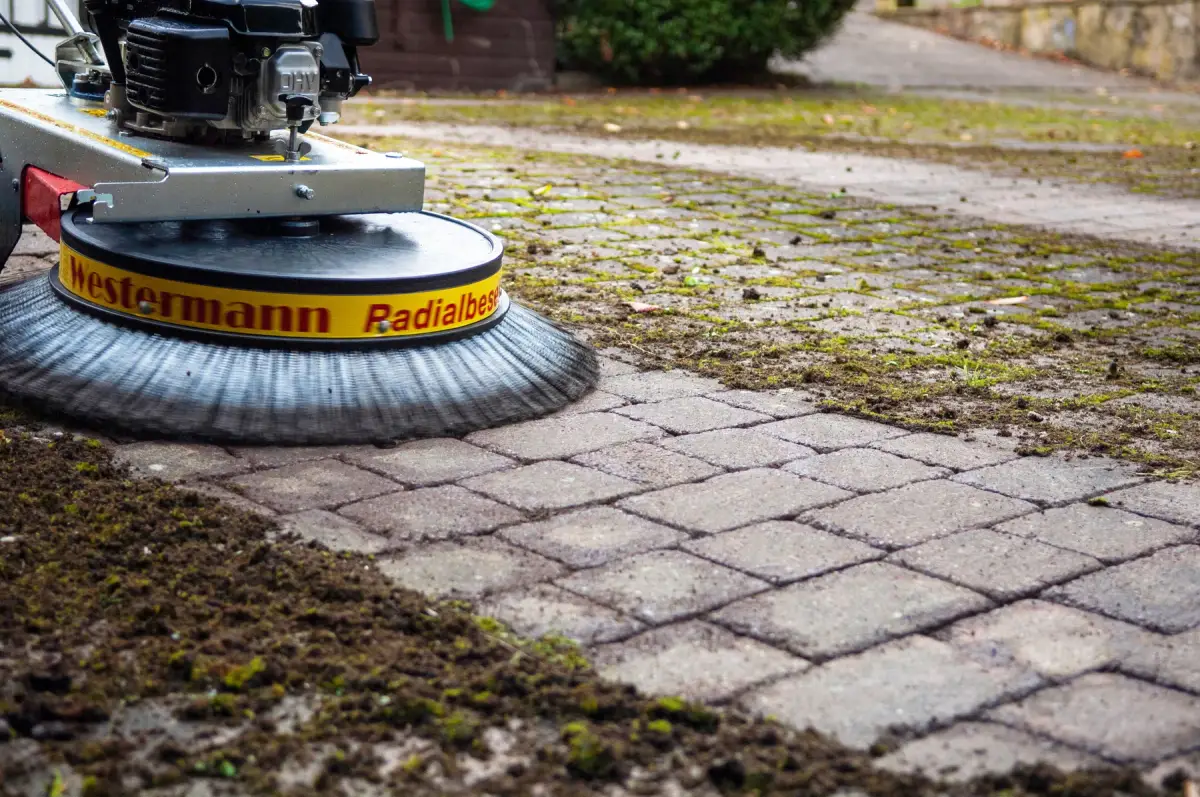
- Paver joints topped up with sand where the wash has drawn them down
- A final rinse so slurry does not dry back onto the surface
Most of the moss work we do is about protecting a building. This page is about the people walking around it. A concrete driveway, a paver path or a run of front steps can grow a thin film of moss and green algae that hardly shows when dry, then turns slick the moment it rains. In Nanaimo it rains a lot from October through March, so that film is wet for months on end. We clear it from concrete, pavers and exposed aggregate across Nanaimo and the surrounding towns, and this is the job where higher pressure sometimes earns its place.
Why a green surface is slippery
Concrete holds a shoe because its surface is rough at a fine scale. A broom finish or the tops of the stones in an aggregate slab give the sole something to bite into. Moss and algae fill that roughness with a soft, waterlogged layer, so your foot lands on the growth rather than on the concrete. Once wet, that layer behaves more like a polished floor than a path.
The danger is easy to miss. A driveway can still look grey from the house while the texture underneath has gone. Most homeowners only notice when somebody slides, usually on a morning when the surface is wet with dew and the light is poor.
Where people slip
Nanaimo is built on hills, and that shapes where the hard surfaces are. Plenty of houses above Departure Bay or on the lower slopes of Mount Benson sit above or below the street, with a steep driveway and a flight of concrete steps between the car and the door. Those are the surfaces that worry us most.
- Steps. The front edge of each tread is where weight lands, and it is often the greenest part, because water sits along the nosing.
- Sloped driveways. A slope turns a slip into a slide. Wheels spin on them too, especially at the bottom where water collects.
- Shaded side paths. The narrow strip between the house and the fence, where bins and the recycling go out, rarely sees sun and almost never dries.
- Under trees. This coast sits in the Coastal Douglas-fir zone. Fir, western red cedar and bigleaf maple drop needles and leaves that mat down on paving and hold water against it.
- Low spots and joints. Any dip that holds a puddle, and every expansion crack and paver joint, stays damp longer than the slab beside it.
Flat, open driveways in the newer subdivisions of the north end tend to stay cleaner, though their shaded edges and the walk along the north wall usually do not.
Low pressure first, more only where it is needed
On a roof we never put high pressure on shingles, and our roof demossing page explains how we work up there instead. Our washing is low pressure by default, on the ground as well, and a soft wash lifts most of the film from a path or patio. Higher pressure is kept for the tasks that need it, such as a concrete driveway or walkway with growth worked deep into the finish. Concrete has no granule coat to strip off, so it can take that. Even then each kind of surface needs its own setting.
Plain concrete. Durable, but older or softer slabs etch. Hold a narrow jet in one place and it leaves a pale stripe that stays for years. We use a wider fan, keep the wand moving, and work in even, overlapping passes so the finish comes out uniform.
Exposed aggregate. This is common on driveways around the city. The stones are held in a cement binder, and it is the binder that fails first. Push too hard and stones come loose, and they do not go back. Patience and distance do the work here, not force.
Pavers. The units are tough. What sits between them is the issue, as the next section explains.
How it works
How a Driveway Moss Job Runs
Ground work is quicker to plan than a roof, but the surface still decides the method. Here is the order we follow.
Tell us what you walk on
Send a photo or two of the driveway, paths and steps, and say whether they are plain concrete, exposed aggregate or pavers.
We look before we spray
On the day we check for etched concrete, loose stones and rocking pavers, then test any higher setting on an out-of-the-way corner.
Scrape, sweep, then wash
Thick growth and litter come off by hand first, then the surface is washed in steady overlapping passes from the top down.
Rinse and walk it with you
We rinse the area clear, re-sand paver joints where needed, and show you which strip is likely to go green first.
That's it.
- You tell us about the roof.
- We give you a clear quote.
- We take the moss off.
- You get one less chore to worry about.
Ready to get the moss off your roof? Get your quote and let us do the climbing.
Paver joints and the sand in them
The sand in paver joints is part of the structure. It wedges each unit against its neighbours so the whole surface carries weight together. Blast it out and pavers start to rock, edges lift, and the open joints hold water and grow more moss than before. A patio that was washed hard and fast is easy to pick out a year later, because the pattern has begun to wander.
So on pavers we stay at low pressure and the wand is angled across the surface rather than straight into the joints. Moss rooted deep in a joint takes some sand with it no matter what, so we top up the joints afterwards wherever they have dropped.
Where the water goes
Everything that washes off a driveway runs somewhere: into a lawn, a flower bed, a catch basin at the foot of the slope or the gutter on the street. We look at that path before the water goes on. Beds along the downhill edge get covered or wetted first, drains get a screen so moss clumps do not wash into them, and we sweep up the solids rather than hosing them away.
After the wash
A clean surface will not stay that way on its own. Shade and moisture brought the growth, and they are still there. Trim the branches that hang over the path, sweep needles off before they mat, and cut hedges back from the edge so the strip beside it can dry. If one dip puddles after every rain, that dip will be the first to go green, and it is worth fixing as a drainage problem.
If moss is also growing in the window frames and sills facing that same shaded path, our window moss removal page covers that job. We also work in Ladysmith, Lantzville and the other mid-island towns on our list.
Our crew started taking moss off driveways and roofs here in 2021. Insurance and WCB registration cover every visit, and so does our guarantee. Tell us what your driveway and paths are made of, send a photo of the worst stretch, and we will give you a free quote.
Why choose us
Why choose us for driveway & sidewalk moss removal
Low pressure first, more only if needed
Every surface starts with a low-pressure soft wash. Broom-finished concrete may get more where it needs it; exposed aggregate rarely does, and pavers stay at low pressure. Each higher setting is tested on a corner first.
Clearing moss since 2021
Five years of mid-island jobs, roofs and ground alike, has taught us which shaded corners go green first and why.
Insured and WCB-registered
Our cover is in place on every job, whether the work is on a roof pitch or a steep set of concrete steps.
Local, and we stand behind it
Nanaimo Moss Removal is locally owned. If a section we washed is not right, we return and put it right.
Got questions?
Driveway and sidewalk moss questions
You will not pressure wash my roof. Why is it fine on my driveway?
Because the two surfaces wear in different ways. A shingle relies on a thin coat of mineral granules, and high pressure strips that coat off for good. Concrete has nothing like it to lose.
Even on the ground we start with a low-pressure soft wash, and step up only where a concrete slab needs it to come clean. Our roof moss removal page explains what we use up top instead.
Will washing my paver patio pull the sand out of the joints?
Some of it, yes, especially where moss has rooted in the joints. Getting the growth out of a joint means disturbing what is in it.
We keep the pressure down and the wand angled across the pavers rather than into the gaps, and we refill joints that have dropped. We tell you before we start if your patio is likely to need it.
My exposed aggregate driveway has a few loose stones already. Can you still clean it?
Usually, with care. Loose stones mean the binder around them is tired, and a close wand will lift more of them.
We point those patches out on the walk-over, wash them at a lower setting from further back, and leave them a little less clean rather than make the damage worse.
Only the steps and the path down the side of the house are green. Why there?
Shade and water. Steps on a north wall or under a fir canopy hardly dry between October and March, and side paths beside a fence or hedge get no sun and little wind.
That is also why those spots are the most dangerous. People use them carrying groceries or bins, often in the dark.
Do you need my outside tap?
Yes. Our washing equipment runs off your water supply. If the tap is shut off for the winter, turn it back on before we arrive or tell us where the valve is.
How long before the moss comes back?
It does come back, and shade sets the pace. A sunny, open driveway can stay clear for a good while. A path under trees on the slopes toward Mount Benson will start to film over once the rains return.
Cutting back overhanging branches and sweeping needles off before they mat down both slow it. Our moss treatment and prevention page covers the same thinking for roofs.
Can you do the driveway on the same visit as the roof?
Yes, and it often makes sense. Moss cleared from a roof lands on the paths and driveway below, so washing the ground last leaves the whole property clean at once.
Ask for both when you request a quote and each part is priced separately.
Driveway & Sidewalk Moss Removal in Nanaimo and the mid-Island
Tell us the address and we will get you a price.